Rare Corvettes · One of one
The Pininfarina Rondine
What happens when you hand America's brashest sports car to Italy's most elegant design house? In 1963 the world found out exactly once. Bill Mitchell sent a bare Sting Ray chassis to Pininfarina, and it came back as the Rondine — a Corvette bodied in hand-formed steel, built to be seen in Paris and never copied.
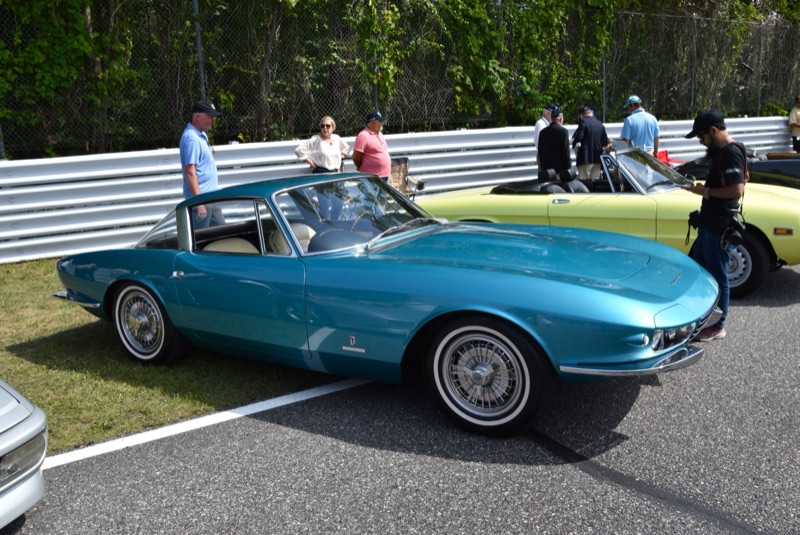
Turin, Italy — 1963
The Rondine (Italian for “swallow,” the bird) was designed by Tom Tjaarda, a Detroit-born architect's son working at Pininfarina — the same pen that would later draw the De Tomaso Pantera and the Fiat 124 Spider. GM design chief Bill Mitchell, who had just fought Zora Arkus-Duntov to a standstill over the split-window Sting Ray, was curious what the Italians would do with the same underpinnings, so he shipped a bare C2 chassis across the Atlantic.
Tjaarda's answer broke one of the Corvette's cardinal rules: where every production Corvette since 1953 wore fiberglass, the Rondine was clothed in hand-formed steel, draped in long, restrained European lines utterly unlike Mitchell's aggressive shark-inspired production car. Underneath sat proper Corvette hardware — a 327-cubic-inch, 360-horsepower fuel-injected V8, a four-speed, and power brakes.
Rondine, by the numbers
- Built: one, on Sting Ray chassis 30837S103720
- Body: hand-formed steel, not fiberglass
- Engine: 327 ci / 360 hp fuel-injected V8, four-speed
- Debut: the 1963 Paris Auto Show
- Then: kept in the Pininfarina museum for 45 years
- Sold: Barrett-Jackson Scottsdale, 2008, for roughly $1.6 million
The forty-five-year hibernation
After starring at the 1963 Paris Auto Show, the Rondine did not go home to Detroit. Pininfarina kept it, and there it stayed — a fixture of the company's own museum for nearly half a century, seen by few, sold to no one. Only in 2008 did it finally cross the block, at Barrett-Jackson in Scottsdale, where the gavel fell around $1.6 million.
There's a delicious irony buried in the Rondine's design credit. Tom Tjaarda's next famous shape was the De Tomaso Pantera — the mid-engine Italian-American exotic whose arrival at Lincoln-Mercury dealers so alarmed GM that it rushed a mid-engine Corvette prototype onto a show stand to answer it. The same hand that dressed a Corvette for Italy helped light the fire under Detroit's own mid-engine dream. See the rest of the one-offs in the rare Corvettes collection.