People · Zora Arkus-Duntov · Chapter 10 of 11
The Mid-Engine Dream
New York Auto Show — April 1970
The silver wedge on the Chevrolet stand should not exist. Eight months earlier the program that built it was dead — canceled by Chevrolet's own general manager, John DeLorean, as too costly and too impractical. Then Ford announced it would sell the Italian-built, mid-engine De Tomaso Pantera through Lincoln-Mercury dealers, and Detroit's oldest reflex — thou shalt not let Ford have a headline — did what none of Zora's memos could. DeLorean ordered one dusty prototype cleaned up and put on a stand. The crowds at the 1970 New York show mob the XP-882. The press declares the mid-engine Corvette imminent. It will remain imminent for fifty years.
The dream was older than most of the people admiring the car. It ran back through the CERV II of 1964 — the all-wheel-drive, aluminum-V8 endurance racer that corporate policy strangled before it ever saw Le Mans — to the CERV I single-seater of 1960, and further still, to a 28-year-old émigré in 1938 Berlin publishing arguments for driving all four wheels. Zora's logic never changed: put the mass amidships, put the power down with the geometry instead of against it, and the Corvette stops being a muscular GT and becomes a weapon of absolute rank.
The parade of almosts
What follows XP-882's show-stand resurrection is the most tantalizing sequence of “almost” in GM history, and Zora is at the center of every frame. DeLorean authorizes new work in 1972: XP-895, whose body is duplicated in aluminum by Reynolds — a mid-engine Corvette light enough to fly. Then the rotary detour: GM has licensed the Wankel, and two of its two-rotor engines are conjoined into a 420-horsepower four-rotor for a low, liquid, gullwinged show car of heartbreaking beauty — many still consider the 1973 Four-Rotor the loveliest Corvette shape never sold.
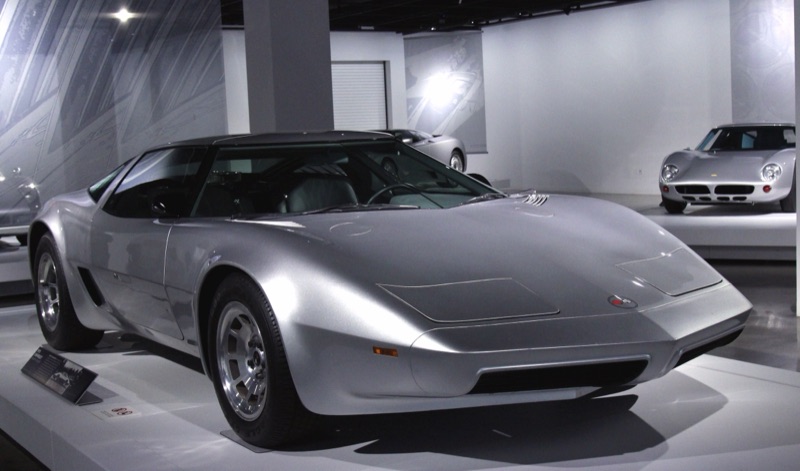
When the fuel crisis kills GM's rotary, the four-rotor car is reborn in 1976 with a conventional 400-cubic-inch small-block between its gullwing doors and a new name: Aerovette. And here the dream comes within a signature of daylight: the Aerovette is approved for production for 1980. Tooling studies begin. Magazine artists render the showroom version. After a quarter century, Zora's car is on the schedule.
Five running mid-engine Corvettes in fourteen years — every one a sensation, every one killed above his head.
You already know it doesn't happen. The dream's protectors leave the stage in quick succession — Ed Cole retires, Bill Mitchell retires, and Zora himself reaches GM's mandatory retirement age. The new Corvette chief engineer, Dave McLellan, inherits a program with finite money, a certainty that the familiar formula sells, and no sentimental attachment to gullwings. The Aerovette dies quietly; the 1984 C4 arrives brilliant, capable — and resolutely front-engined. The mid-engine Corvette returns to what it had always been: Zora's argument, waiting for history to accept it.
He never stopped making the argument. Not in the building, and not after they gave him a gold watch and the industry's fondest farewell. It would take GM until the year 2020 — twenty-four years after his death — to concede the point, and when it finally did, the company etched its concession into the car itself: every mid-engine C8 carries Zora's silhouette printed low on the passenger side of the windshield, and stamped — for anyone devoted enough to crawl underneath — into the belly pan.