People · Zora Arkus-Duntov · Chapter 11 of 11
Legacy
General Motors — January 1, 1975
The rules that could never quite stop Zora Arkus-Duntov finally get him on a technicality: the calendar. GM's mandatory retirement age is sixty-five, and on New Year's Day 1975 — twenty-two years, eight months, and one revolution after he walked into Chevrolet R&D with a top-speed paper under his arm — his badge stops working. The Corvette passes to Dave McLellan, a gifted engineer with his own ideas and his own era's constraints. Zora leaves behind a car strangled by emissions rules and safety bumpers, yet still — thanks to two decades of his stubbornness — the only American sports car that matters.
Retirement, for Zora, is a word other people use. He consults. He flies airplanes. He lends his name and his engineering to the Duntov Turbo Corvettes built with American Custom Industries — because if GM won't chase more power, someone should. He and Elfi become the royalty of the Corvette show circuit: the accent, the cigarette, the dancer on his arm, mobbed by owners who understand precisely what they owe him. He signs dashboards, engine bays, posters, arms. He tells the truth in interviews with a freedom GM never permitted, and the quotes are all the better for it.
Bowling Green, Kentucky — Labor Day weekend, 1994
When the National Corvette Museum opens across the road from the Bowling Green assembly plant, Zora is there — part founding father, part living exhibit, entirely in his element. The museum is the fandom's cathedral, and everyone in the building knows who its patron saint is.
Zora Arkus-Duntov died on April 21, 1996, at St. John's Hospital in Grosse Pointe, Michigan, at eighty-six. And then he did the most Zora thing of all: he stayed. His ashes were entombed inside the National Corvette Museum, where they rest today — the engineer permanently garaged with the cars, greeting every visitor who comes to see what his life's work became. Elfi, his partner in every escape and every victory lap, guarded the legend for the rest of her own life.
Harley Earl imagined the Corvette. Ed Cole empowered it. Bill Mitchell made it beautiful. Zora made it matter.
Bowling Green — 2020
The final scene he never saw. In 2020, the eighth-generation Corvette arrived with its engine behind the driver — the layout of the CERV I, of CERV II, of XP-882 and the Aerovette, of every beautiful doomed prototype in Chapter 10 — and promptly became the fastest-accelerating, best-balanced, most internationally respected Corvette ever built. The C8's engineers made no secret of whose argument they were finishing: his silhouette rides on every windshield and belly pan. Then came the part even Zora might not have dared put in a memo: the electrified all-wheel-drive E-Ray and 1,250-horsepower ZR1X — production Corvettes driving all four wheels, eight decades after a young émigré engineer in Berlin published a paper insisting that was the future.
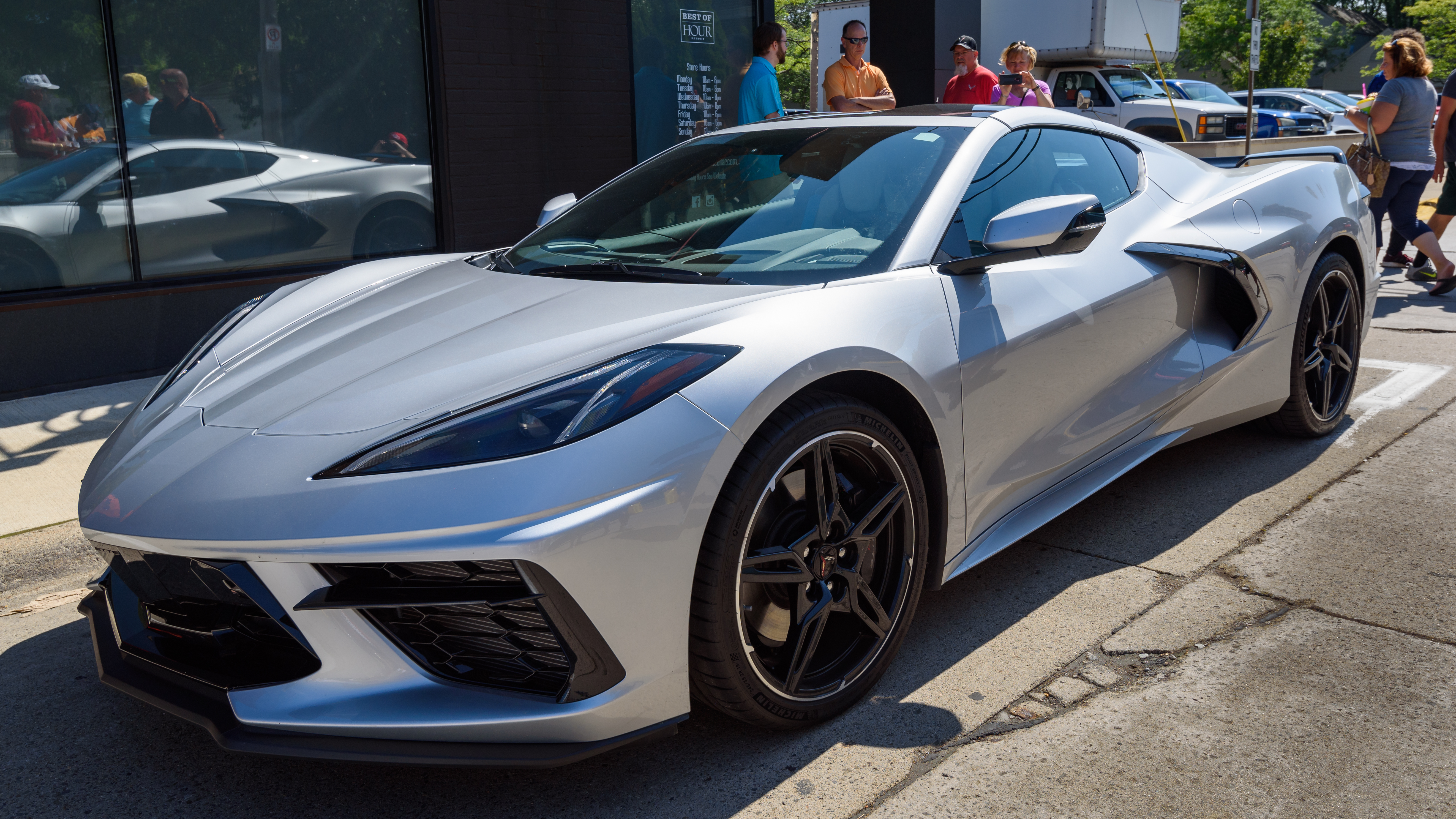
Was he “the Father of the Corvette”? Strictly, no — the car existed before he did, a pretty six-cylinder promise on a Motorama turntable. What Zora was, was rarer: the man who refused to let the promise stay unkept. Every fuel-injected 283, every Z06 and Grand Sport and L88, every independent rear suspension and four-wheel disc, every record on a mountain, a beach, or the Mulsanne straight — and finally, a generation late, the mid-engine car itself — exists because a twice-exiled engineer with an unplaceable accent decided America deserved a real sports car, and never once took no for an answer.
The production numbers are on the year pages of this site. The soul behind them was Zora.