Rare Corvettes · One of one
The Aerovette
Of all the mid-engine Corvette prototypes that dazzled auto shows and died in boardrooms, the Aerovette came the closest to daylight. It was approved for production. Tooling studies began. And then, at the last moment, the people who believed in it walked out the door — and it died with them.
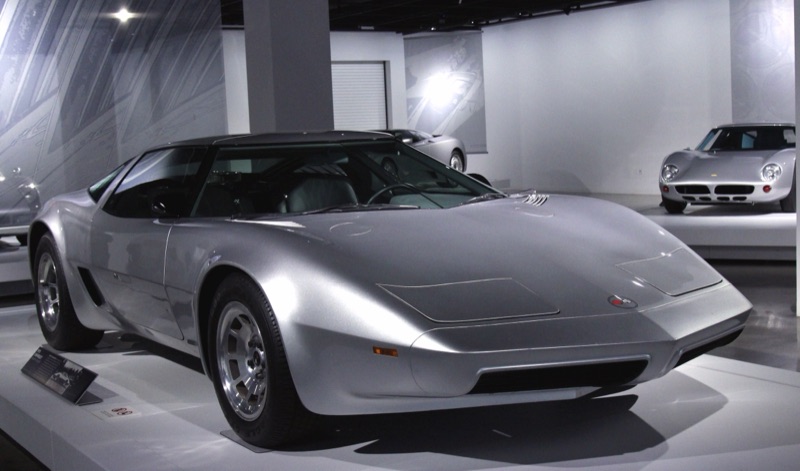
The car's story runs backward through a tangle of project codes. It began as the XP-882, a mid-engine prototype from 1969 that John DeLorean canceled, then revived to answer the De Tomaso Pantera at the 1970 New York show. It continued as the Reynolds-aluminum XP-895, and then as a jewel of a four-rotor show car in 1973 — two Chevy Vega Wankel rotary engines joined into one 420-horsepower unit, wrapped in a low, liquid, gullwinged body many still consider the most beautiful shape ever to wear a Corvette badge.
When the 1970s fuel crisis killed GM's rotary program, the four-rotor car was re-engined in 1976 with a conventional 400-cubic-inch small-block V8 and given a new name: Aerovette. And this time it very nearly happened — the Aerovette was approved for production for the 1980 model year.
Aerovette at a glance
- Lineage: XP-882 (1969) → XP-895 (1972) → four-rotor (1973) → Aerovette (1976)
- Body: low mid-engine coupe with gullwing doors
- Engine: a 420-hp four-rotor Wankel, later a 400-ci small-block V8
- Approved for 1980 production — then canceled
The cancellation was a matter of timing and people. Its great patrons left the stage in quick succession — Zora Arkus-Duntov retired, Ed Cole and design chief Bill Mitchell followed — and the new Corvette chief, Dave McLellan, judged a front-engine car cheaper to build and faster to sell. The Aerovette was shelved, the C4 arrived front-engined, and the mid-engine dream waited another forty years for the C8. Read the full saga in Zora's mid-engine chapter, or see the rest of the rare Corvettes.