People · Zora Arkus-Duntov · Chapter 3 of 11
The Escape
France — 1939–1940
When the war comes, the Arkus-Duntov brothers do not run. They enlist. Zora and Yura join the French Air Force — two Russian-born Jewish émigrés volunteering to fly for their adopted country against the regime they escaped. Then, in May 1940, the German army does to France in six weeks what four years of the previous war could not, and suddenly the question is no longer how to fight. It is how to live until Friday.
What follows is the stuff of films — except it is documented fact. With France collapsing, Zora works the crumbling bureaucracy and secures exit visas from the Spanish consulate in Marseilles: for himself, for Elfi, for Yura, for his parents. One family, snatched whole out of the fire. But Elfi is not in Marseilles. She is in Paris — and the Wehrmacht is arriving.
So the twenty-year-old dancer gets into her little MG, alone, and drives. South out of Paris into the greatest refugee river in European history — millions on the roads, columns strafed from the air, fuel almost unobtainable — one small open sports car threading through the chaos to Bordeaux, one step ahead of the German army. She makes it. Days later she and Zora find each other, the family crosses into Portugal, and from Lisbon they board a ship for New York.
Husband and wife, matched: he escaped Europe with visas and nerve; she outran an invasion in an MG.
New York City — the 1940s
America gets the Arkus-Duntov brothers at full boil. They set up shop in New York as the Ardun Mechanical Corporation — AR from Arkus, DUN from Duntov — doing precision war work, machining and engineering for the military. Competence pays the rent. But when the war ends, Ardun pivots to the project that makes the name immortal in American hot rodding.
The Ford flathead V8 was America's engine — cheap, everywhere, beloved — and aerodynamically asthmatic, its exhaust routed through the block, its breathing strangled by its own architecture, prone to cooking itself under load. Zora's answer was surgical: throw the flat heads away. In their place, Ardun built gorgeous cast-aluminum overhead-valve conversion heads with hemispherical combustion chambers — "hemi" heads for the people's engine, years before Chrysler made the word famous. Breathing freed, a warmed-up Ardun flathead could push past 300 horsepower in an era when the stock engine made about a hundred. Hot rodders and land-speed racers treated the kits like religious artifacts then. They still do: genuine Ardun heads are museum pieces today, and the design has been revived and reproduced by devotees ever since.
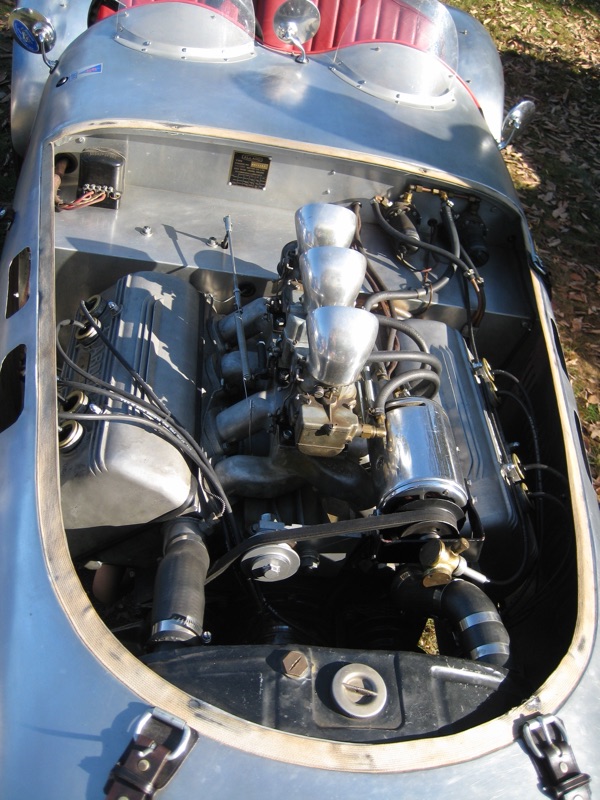
England — 1950
The Ardun heads earn Zora exactly the right kind of fame. In 1950 Sydney Allard — the London builder stuffing big American V8s into brutal, minimalist British sports cars — brings him across the Atlantic to develop the breed. Allards were crude and magnificent, and they were competitive at the very top: an Allard finished third overall at Le Mans in 1950.
Development work comes with a helmet. Zora co-drives the 24 Hours of Le Mans in Allard J2s in 1952 and 1953 — full factory-class endurance racing against Ferrari, Jaguar, and Mercedes-Benz. The results are unkind (Allards were fast until they weren't), but the education is priceless. By his mid-forties, Zora Arkus-Duntov has been a supercharging theorist, a war materiel engineer, a speed-parts industrialist, and a works-level endurance racer. There is no one else on Earth with quite this résumé.
In 1952, back in the States and consulting for Fairchild Aviation, he is professionally restless. The Ardun adventure is behind him; the Allard chapter is winding down; American sports car culture is exploding around him, entirely powered by European machinery. What he needs — though he doesn't know it yet — is waiting under stage lights in the ballroom of a Manhattan hotel.
It is white. It is gorgeous. And it is, in Zora's cold professional judgment, a complete fraud.