People · Harley Earl · Chapter 3 of 6
Dream Cars
Detroit — 1938
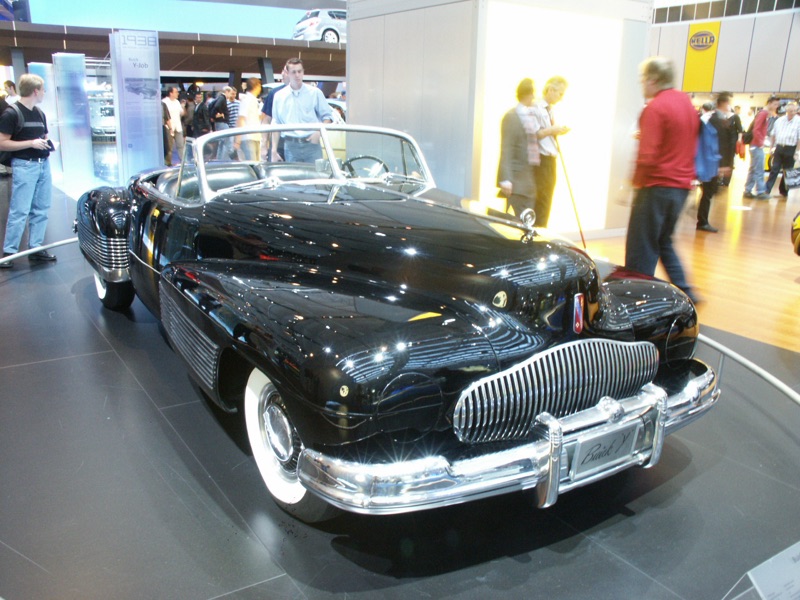
By the late 1930s Earl has a decade of Art and Colour behind him and an itch no production car can scratch: he wants to build something with no customer, no cost target, no engineering committee — a car that exists purely to show what's possible. The result is the Buick Y-Job, unveiled in 1938, and automotive history doesn't really have a name for what it is yet, so Earl invents one: the concept car. Low, sleek, with power windows and hidden headlamps years ahead of anything in a showroom, the Y-Job is no static mockup — it runs, and Earl drives it as his personal car through the summers that follow, a rolling advertisement for a future Buick isn't selling yet.
The fin that started a war
A decade later Earl authorizes designer Frank Hershey's proposal for the 1948 Cadillac: two small vertical blades rising from the rear fenders, borrowed — quite openly — from the twin tail booms of the Lockheed P-38 Lightning fighter, an airplane Earl had reportedly toured and admired. It is a small, almost hesitant detail on the '48 car. It does not stay small. Through the 1950s, as jets and rockets seize the public imagination, Earl's fins grow year over year, escalating into an open styling arms race with his opposite number at Chrysler, Virgil Exner — a rivalry that peaks with the towering, gull-wing fins of the 1959 Cadillac, chrome and glass stretched to the edge of parody. Critics call it excess. Buyers call it exactly what they want. Both are right.
What Earl's studio gave Detroit
- The wraparound windshield
- The hardtop sedan (a "convertible" roofline with real doors and pillars)
- Factory two-tone paint as a mainstream option
- The tailfin — arguably the single most recognizable design signature of 1950s America
The Motorama years, 1949–1960
A concept car locked in a Detroit studio convinces no one. So, with Sloan's backing, Earl turns the dream car into a traveling show: Motorama, a glittering multi-city spectacle of turntables, orchestras, showgirls, and rotating chrome fantasies — the Firebird gas-turbine cars, the Olds Golden Rocket, the Buick LeSabre — that let ordinary Americans vote with their eyes on GM's future before the company committed a dollar of tooling budget to build it. Some Motorama dream cars stay dreams forever. A few become production reality, reshaping their entire divisions.
And one January night in 1953, at the grandest Motorama venue of them all — the Waldorf-Astoria in New York — Earl rolls out a low white two-seater he has pushed his own experimental department to build, betting that the servicemen coming home with a taste for European roadsters are a market Detroit has been ignoring for years.