People · Harley Earl · Chapter 2 of 6
Sloan's Gamble
Detroit, Michigan — 1925–1927
Lawrence Fisher, the Cadillac general manager whose family's coachbuilding firm supplies bodies to half of GM, has heard about the Hollywood customizer who dresses up cars for movie stars. He commissions Earl to design a new companion car for Cadillac — something sportier, sharper, aimed at buyers Cadillac's staid engineering department has never quite known how to reach. The result, badged LaSalle, arrives for 1927: lower, longer-hooded, its lines drawn by a man who thinks about a car's silhouette the way his old Hollywood clients thought about a costume.
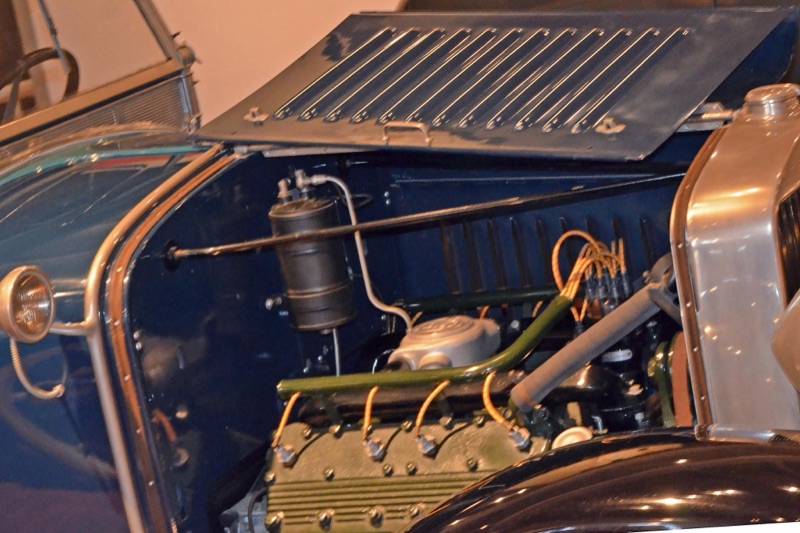
The LaSalle sells. More importantly, it gets noticed by the one man in Detroit whose opinion can turn a good-looking car into an entire corporate philosophy: GM president Alfred P. Sloan. Sloan runs the largest industrial enterprise on Earth by a simple insight — that a car company sells a ladder of aspiration, a brand for every income and every ambition — and he watches the LaSalle prove that appearance could be engineered on purpose, the same way horsepower or fuel economy could. On June 23, 1927, GM's Executive Committee approves something that has never existed anywhere in the industry: a department whose entire job is the look of the automobile. Sloan calls it the Art and Colour Section. He puts the Hollywood coachbuilder in charge of it.
Every automaker before this built bodies the way a factory built anything else: for function and for cost. Earl's department existed to ask a third question — does it look like something you want?
The reception inside GM is not warm. Engineers and division heads — men who had run their fiefdoms by slide rule for two decades — regard Earl's fifty-odd designers, modelers, and colorists as decorators playing at engineering. “Pretty picture boys,” the shop floor calls them; the studio itself earns the nickname “the Beauty Parlor.” Earl, characteristically, does not shrink from the theater of it. He is six-foot-four, immaculately dressed, given to entrances — and he makes sure that within General Motors, in matters of styling, there is only one name that matters. His own. Other designers in his department are, for years, forbidden from being publicly credited at all. It is not modesty. It is brand management, applied to himself.
The technique that makes his vision possible is his own invention too: clay modeling. Instead of committing to a shape in expensive, unforgiving sheet metal, Earl's studio sculpts full-size car bodies in soft clay — reworked, reshaped, argued over, and reworked again until the form is right, at a fraction of the cost of cutting real metal for every idea. It sounds obvious in hindsight. In 1927, it is a revolution in how cars get designed at all, and the method remains the industry standard for the rest of the twentieth century.
Within a few years, "Mr. Earl" — as everyone at GM, from executives to machinists, learns to call him — is not just running a department. He is inventing the whole idea that a car company needs one.