People · Zora Arkus-Duntov · Chapter 7 of 11
Sting Ray Wars
GM Styling, Warren, Michigan — 1962
The clay model is jaw-dropping and everyone in the room knows it. Bill Mitchell's team has translated the Stingray Racer and the Mako Shark show car into a production coupe of pure menace — hidden headlamps, a beltline like a blade, and down the center of the fastback rear glass, Mitchell's signature flourish: a body-color spine splitting the window in two. Zora looks at the spine and sees one thing only: the exact spot in the mirror where a following car disappears.
The fight that follows has entered legend — two brilliant, theatrical, immovable men, the stylist and the engineer, bellowing at each other across the car's roof. Mitchell insists the split is the design. Zora replies, in effect, that a sports car you cannot see out of is a styling exercise, not a machine. Both take it upstairs. For 1963, Mitchell wins: the spine stays. For 1964, Zora wins: the spine goes, replaced by a single pane. History, with its usual sense of humor, sides with both of them — the one-year-only “split-window” becomes the most coveted production Corvette of them all. (Mitchell tells his side of the same argument in his own chapter.)
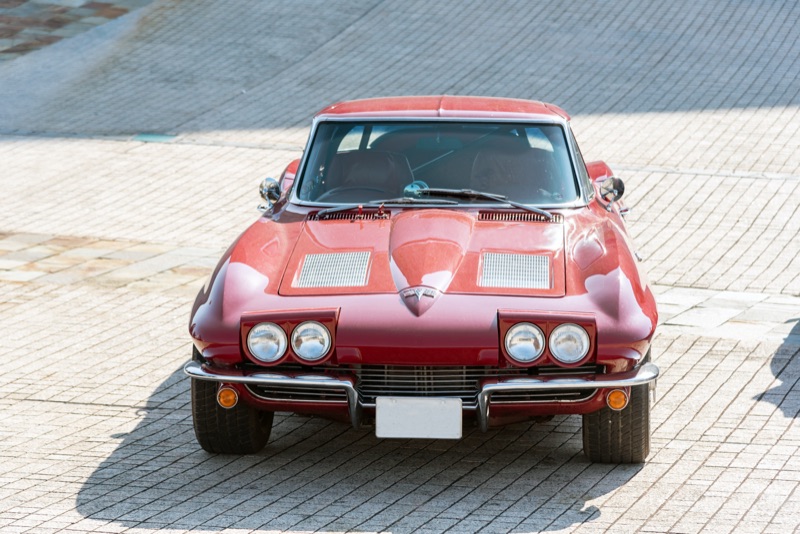
Under the drama, the 1963 Sting Ray is Zora's finest production hour yet. A stiff new ladder frame. Steering and weight distribution transformed. And the headline: independent rear suspension — a first for an American production car of this class, executed with a clever transverse leaf spring to fit both the budget and the bodywork. The car sells so furiously the plant adds a second shift and still cannot keep up. The neither-fish-nor-fowl roadster of 1954 is now, by acclamation, a world-class GT.
The order sheet as a weapon
The racing ban still stands, so Zora does what he has learned to do: he hides the race car inside the option book. For 1963 that means RPO Z06 — an innocuous code unlocking the fuel-injected 327, a four-speed, Positraction, vastly upgraded brakes with race-grade linings, stiffened springs and bars, and (for the truly committed) a 36-gallon fuel tank for endurance events. No factory team, no factory drivers — just a turn-key racer any privateer could order from a dealer. The letters Z-0-6 would echo through Corvette history for the next sixty years.
The Z06 wins on its very first weekend, at Riverside in October 1962, Doug Hooper's car surviving a three-hour brawl. But the sharpest eyes in the paddock are not on the winner. They are on the skinny British roadster with the Ford V8 that led easily until it broke — the very first Shelby Cobra. Zora reads the future in a glance: the Cobra weighs roughly a thousand pounds less than his Sting Ray. No cam, no linings, no option code can argue with mass.
A production Corvette cannot beat that car. So Zora — quietly, without asking anyone's permission twice — begins building a Corvette that isn't a production car at all.