People · Betty Skelton · Chapter 3 of 9
First Lady of Aerobatics
The air show circuit — 1948–1951
On January 1, 1948, flying a Great Lakes biplane, Betty Skelton wins the International Feminine Aerobatic Championship. She wins it again in 1949. She wins it a third consecutive time in 1950. In competitive aerobatics — a sport measured in fractions of a second and degrees of precision, where a pilot's entire body is the instrument being judged — three straight world titles is not a streak. It's a statement.
Little Stinker
Success buys her the tool she actually wants. In August 1948, fresh off her first championship, Skelton buys a Pitts Special S-1C — an experimental, single-seat, open-cockpit biplane weighing barely 544 pounds, the smallest aerobatic aircraft in existence at the time. She has it repainted a dramatic red and white and christens it Little Stinker. It becomes, in short order, the most recognizable airplane in American women's aviation.
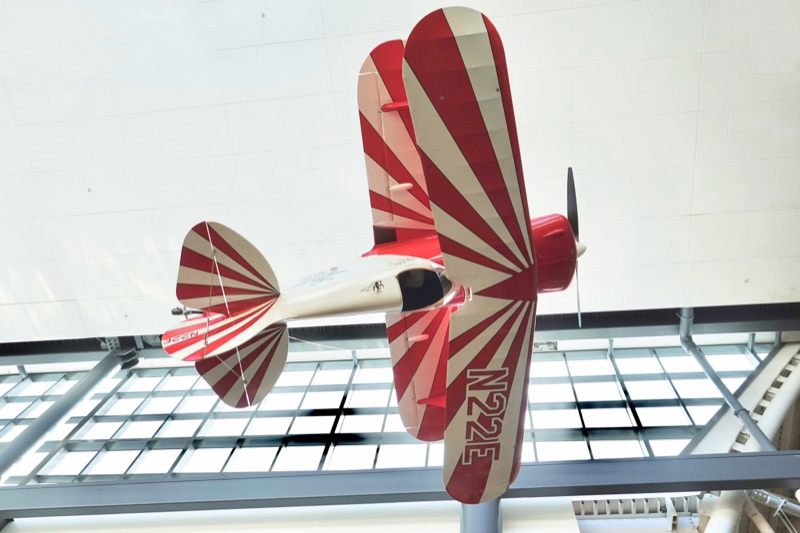
The plane earns its own small piece of aviation folklore. On some flights Skelton's pet Chihuahua, also named Little Tinker, joins her in the cockpit — fitted, this being Betty Skelton, with a custom-made working parachute of its own. And the signature move of her entire routine is not subtle: flying inverted, roughly ten feet above the ground, she slices through a ribbon strung between two fishing poles using nothing but her propeller. It is the kind of stunt that either kills a pilot or makes their career. For Skelton, performed correctly and repeatedly, it does the latter.
World records set in this era
- 1949 — World light-plane altitude record, 25,763 feet, flying a Piper Cub
- 1951 — Breaks her own record: 29,050 feet, again in a Piper Cub
- 1948–1950 — Three consecutive International Feminine Aerobatic Championships
Walking away
After the third championship in 1950, Skelton makes a decision that says as much about her as any trophy: she quits. Not from injury, not from a sponsor pulling out — she is, by her own account, mentally and physically worn down by the relentless grind of the nonstop air-show circuit, and more to the point, she has run out of competition worth having. Nobody left to beat. In 1951 she sells Little Stinker and steps away from competitive aerobatics for good, at the exact peak of her powers.
Three championships, two world records, one decision to leave while she was still winning.
It is a pattern that will repeat throughout her life — Skelton rarely leaves a field because she failed at it. She leaves because she has already won it, and something else has caught her attention. In 1951, that something else has an engine, four wheels, and an entire industry that has never once let a woman get behind it professionally.